
MAM5-INUM - Commande
TP 4
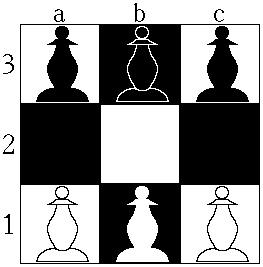
Hexapawn
See: Gardner, M. The unexpected hanging and other mathematical diversions. Chicago Press, 1991.
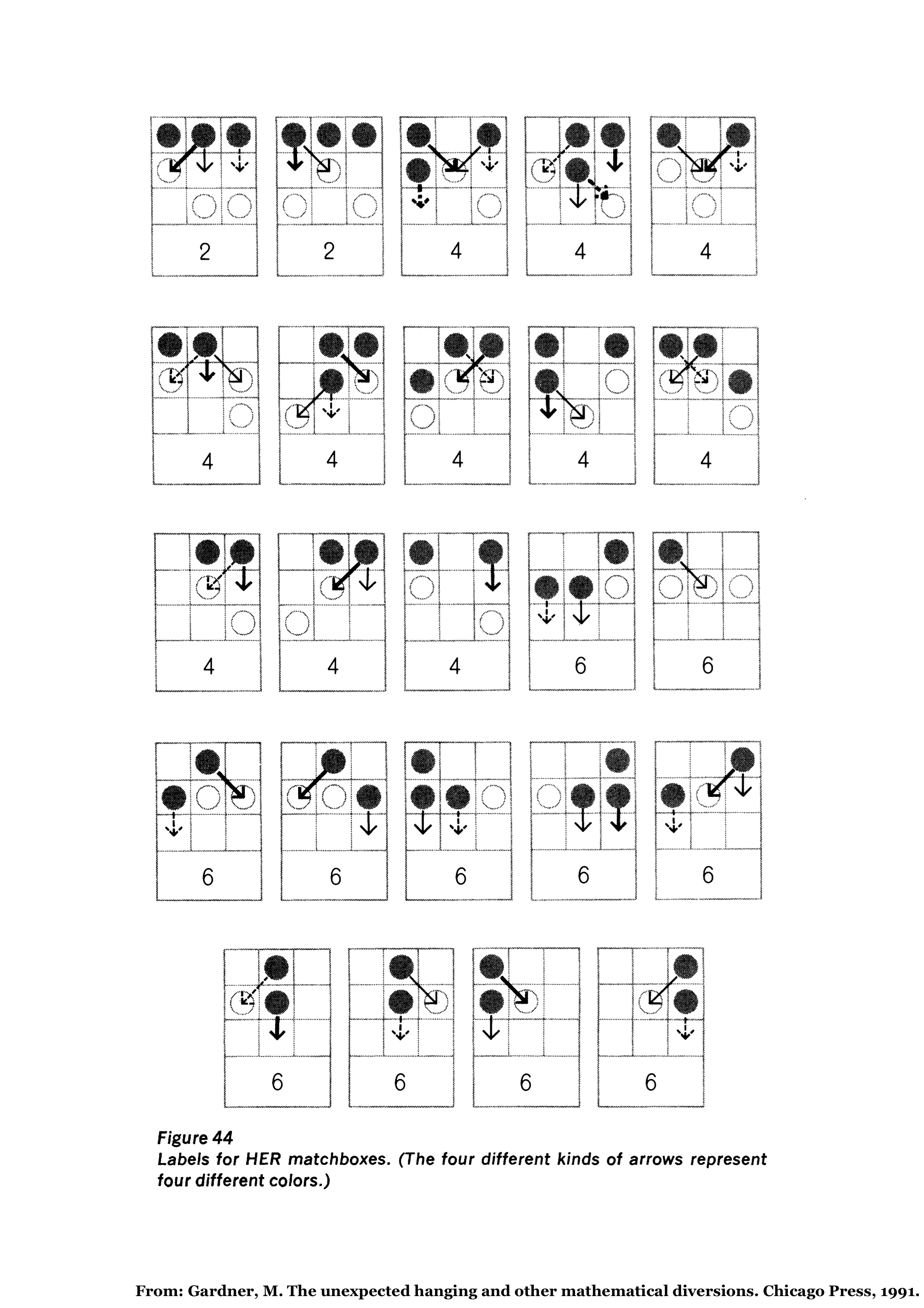
Reinforcement
function b = member(x, l)
% member -- Membership test
%
%  Usage
%    b = member(x, l)
%
%  Inputs
%    x      numerical value
%    l      list
%
%  Outputs
%    b      boolean
%
%  Description
%    True if x belongs to l.
%
%  See also
%    cell arrays
%

b = 0;
n = length(l);
i = 1;

while ~b & (i <= n)
  if ( norm(l{i} - x) == 0 )
    b = 1;
  else
    i = i+1;
  end;
end;

end % function
function ll = prune(x, l)
% prune -- Prunes value
%
% Usage
% ll = prune(x, l)
%
% Inputs
% x numerical value
% l list
%
% Outputs
% ll list
%
% Description
% Prunes all occurences of x (if present) from list l
%
% See also
% cell arrays
%
ll = { };
for i = 1:length(l)
if (norm(l{i} - x) > 0), ll = { ll{:} l{i} }; end;
end;
end % functionfunction llu = reinforce(X, u, lX, lu);
% reinforce -- Control reinforcement
%
% Usage
% llu = reinforce(X, u, lX, lu)
%
% Inputs
% X 3 x 3 matrix, state
% u 2 x 2 matrix, control
% lX list of states
% lu list of list of controls (one list pear possible state in lX)
%
% Outputs
% llu list of list of controls (updated)
%
% Description
% Finds the list corresponding to state X in lu, and prunes u from it.
% Error if X is not found in lX, or if u is not found in the list.
%
% See also
% prune
%
llu = lu; # UPDATE
end % functionDynamics of player1 (white) and player2 (black / AI)
function Y = f1(X, u)
% f1 -- Dynamics of player1
%
%  Usage
%    Y = f1(X, u)
%
%  Inputs
%    X      3 x 3 matrix, state
%    u      2 x 2 matrix, control
%
%  Outputs
%    Y      3 x 3 matrix, new state
%
%  Description
%    Transition from state X when player1 applies control u
%
%  See also
%    f2
%

if X(u(1, 1), u(1, 2)) ~= 1
  error('Wrong move.');
end;

Y = X;
Y(u(1, 1), u(1, 2)) = 0;
Y(u(2, 1), u(2, 2)) = 1;

end % function
function Y = f2(X, u)
% f2 -- Dynamics of player2
%
% Usage
% Y = f2(X, u)
%
% Inputs
% X 3 x 3 matrix, state
% u 2 x 2 matrix, control
%
% Outputs
% Y 3 x 3 matrix, new state
%
% Description
% Transition from state X when player2 applies control u
%
% See also
% f1
%
if X(u(1, 1), u(1, 2)) ~= 2
error('Wrong move.');
end;
Y = X;
Y(u(1, 1), u(1, 2)) = 0;
Y(u(2, 1), u(2, 2)) = 2;
end % functionRandom player1 and player2
function u = play1(X, inter)
% play1 -- Random control generation for player1
%
%  Usage
%    u = play1(X)
%    u = play1(X, inter)
%
%  Inputs
%    X      3 x 3 matrix, state
%    inter  boolean, interactive player1 [ False ]
%
%  Outputs
%    u      control
%
%  Description
%    Generates an admissible random move for player1 from state X. Error if no move is
%    allowed.
%
%  See also
%    play2
%

if (nargin == 1)
  inter = 0;
end;

lu = gen1(X);
n = length(lu);

if (n == 0), error('No possible move.'); end;

if inter
  disp('Player 1 possible moves:')
  for i = 1:n, disp(f1(X,lu{i})); end
  while 1
    i = input('Move ? ');
    if (i >= 1) & (i <= n), break; end;
  end;
  u = lu{i};

else

  u = lu{randi(n, 1)};

end;

end % function
function u = play2(X, lX, lu)
% play2 -- Random control generation for player2
%
% Usage
% u = play2(X, lX, lu)
%
% Inputs
% X 3 x 3 matrix, state
% lX list of states
% lu list of list of controls (one list per possible state in lX)
%
% Outputs
% u control
%
% Description
% Picks in lu an admissible random move for player2 from state X. Empty [ ] control
% if no move is allowed.
%
% See also
% play1
%
n = length(lX);
i = 1;
found = 0;
while (~found) & (i <= n)
if (norm(lX{i}-X) == 0)
found = 1;
l = lu{i};
else
i = i+1;
end;
end;
if found
m = length(l);
if (m == 0)
u = [ ];
else
u = l{randi(m, 1)};
end;
else
u = [ ];
end;
end % functionWin test for player1 and 2
function b = win1(X)
% win1 -- Win test for player1
%
%  Usage
%    b = win1(X)
%
%  Inputs
%    X      3 x 3 matrix, state
%
%  Outputs
%    b      boolean, true if player1 wins
%
%  Description
%    Player1 wins if (i) she reaches i=1, (ii) or she has taken all of player2 pawns,
%    (iii) or player2 cannot play any move.
%
%  See also
%    win2
%

if ~isempty( find(X(1, :) == 1)  ) % case (i)
  b = 1;

elseif isempty( find(X == 2)  )    % case (ii)
  b = 1;

elseif isempty( gen2(X) )          % case (iii)
  b = 1;

else
  b = 0;

end;

end % function
function b = win2(X)
% win2 -- Win test for player2
%
% Usage
% b = win2(X)
%
% Inputs
% X 3 x 3 matrix, state
%
% Outputs
% b boolean, true if player2 wins
%
% Description
% Player2 wins if (i) she reaches i=3, (ii) or she has taken all of player1 pawns,
% (iii) or player1 cannot play any move.
%
% See also
% win1
%
if ~isempty( find(X(3, :) == 2) ) % case (i)
b = 1;
elseif isempty( find(X == 1) ) % case (ii)
b = 1;
elseif isempty( gen1(X) ) % case (iii)
b = 1;
else
b = 0;
end;
end % functionGeneration of admissible controls for player1 and player2
function lu = gen1(X)
% gen1 -- Control generation for player1
%
%  Usage
%    lu = gen1(X)
%
%  Inputs
%    X      3 x 3 matrix, state
%
%  Outputs
%    lu     list of controls
%
%  Description
%    Generates all possible moves for player1 from state X.
%
%  See also
%    gen2
%

lu = { };

[ i, j ] = find(X == 1);

for k = 1:length(i)

  if (i(k) >= 2) % move
    if (X(i(k)-1, j(k)) == 0)
      u = [ i(k)   j(k)
            i(k)-1 j(k) ];
      lu = { lu{:} u };
    end;
  end;

  if (i(k) >= 2) & (j(k) >=2) % take (1/2)
    if (X(i(k)-1, j(k)-1) == 2)
      u = [ i(k)   j(k)
            i(k)-1 j(k)-1 ];
      lu = { lu{:} u };
    end;
  end;

  if (i(k) >= 2) & (j(k) <=2) % take (2/2)
    if (X(i(k)-1, j(k)+1) == 2)
      u = [ i(k)   j(k)
            i(k)-1 j(k)+1 ];
      lu = { lu{:} u };
    end;
  end;

end;

end % function
function lu = gen2(X)
% gen2 -- Control generation for player2
%
% Usage
% lu = gen2(X)
%
% Inputs
% X 3 x 3 matrix, state
%
% Outputs
% lu list of controls
%
% Description
% Generates all possible moves for player2 from state X.
%
% See also
% gen1
%
lu = { };
[ i, j ] = find(X == 2);
for k = 1:length(i)
if (i(k) <= 2) % move
if (X(i(k)+1, j(k)) == 0)
u = [ i(k) j(k)
i(k)+1 j(k) ];
lu = { lu{:} u };
end;
end;
if (i(k) <= 2) & (j(k) >=2) % take (1/2)
if (X(i(k)+1, j(k)-1) == 1)
u = [ i(k) j(k)
i(k)+1 j(k)-1 ];
lu = { lu{:} u };
end;
end;
if (i(k) <= 2) & (j(k) <=2) % take (2/2)
if (X(i(k)+1, j(k)+1) == 1)
u = [ i(k) j(k)
i(k)+1 j(k)+1 ];
lu = { lu{:} u };
end;
end;
end;
end % functionGame
function [ llu1, llu3, llu5, winner ] = game(lu1, lu3, lu5, inter, dsp)
% game -- Hexapawn game
%
%  Usage
%    [ llu1, llu3, llu5, winner ] = game(lu1, lu3, lu5)
%    [ llu1, llu3, llu5, winner ] = game(lu1, lu3, lu5, inter, dsp)
%
%  Inputs
%    lu1    list, possible controls for u1 depending on X1
%    lu3    list, possible controls for u3 depending on X3
%    lu5    list, possible controls for u5 depending on X5
%    inter  boolean, interactive player1 [ False ]
%    dsp    boolean, display states [ False ]
%
%  Outputs
%    llu1   list, reinforcement of lu1
%    llu3   list, reinforcement of lu3
%    llu5   list, reinforcement of lu5
%    winner integer, 1 or 2
%
%  Description
%    Plays one Hexapawn game and reinforces player2 controls.
%
%  See also
%    reinforce
%

global lX1
global lX3
global lX5

if (nargin == 3)
  inter = 0;
  dsp = 0;
elseif (nargin == 4)
  dsp = 0;
end;

X0 = [ 2 2 2
       0 0 0
       1 1 1 ];
if dsp, disp('Initial game:'); disp(X0); end;

% Move 0: player1
while 1
  u0 = play1(X0, inter);
  if norm(u0 - [ 3 3 ; 2 3 ]) > 0,
    break;
  else
    if inter, disp('No right opening!'); end;
  end;
end;

X1 = f1(X0, u0); % no possible win after u0
if dsp, disp('Player 1 move:'); disp(X1); end;

% Move 1: player2
u1 = play2(X1, lX1, lu1);
X2 = f2(X1, u1); % no possible win after u1
if dsp, disp('Player 2 move:'); disp(X2); end;

% Move 2: player1
u2 = play1(X2, inter);
X3 = f1(X2, u2);
if dsp, disp('Player 1 move:'); disp(X3); end;

if win1(X3) || isempty(play2(X3, lX3, lu3))
  winner = 1;
  lu1 = reinforce(X1, u1, lX1, lu1);

else

% Move 3: player2
u3 = play2(X3, lX3, lu3);
X4 = f2(X3, u3);
if dsp, disp('Player 2 move:'); disp(X4); end;

if win2(X4)
  winner = 2;

else

% Move 4: player1
u4 = play1(X4, inter);
X5 = f1(X4, u4);
if dsp, disp('Player 1 move:'); disp(X5); end;

if win1(X5) || isempty(play2(X5, lX5, lu5))
  winner = 1;
  lu3 = reinforce(X3, u3, lX3, lu3);

else

% Move 5: player2
u5 = play2(X5, lX5, lu5);
X6 = f2(X5, u5);
if dsp, disp('Player 2 move:'); disp(X6); end;

if win2(X6)
  winner = 2;

else
  winner = 1; % useless to play last move
  lu5 = reinforce(X5, u5, lX5, lu5);

end, end, end, end;

llu1 = lu1;
llu3 = lu3;
llu5 = lu5;

end % function
Iterated game for learning
% main

% List of states for X1, X3 and X5

global lX1
global lX3
global lX5

lX1 = { [ 2 2 2
          1 0 0
        0 1 1 ] ...
                  ...
      [ 2 2 2
        0 1 0
        1 0 1 ] };

lX3 = { [ 2 0 2
          2 1 0
        0 0 1 ] ...
                ...
      [ 0 2 2
        1 2 0
        0 0 1 ] ...
                ...
      [ 2 0 2
        1 1 0
        0 1 0 ] ...
                ...
        [ 2 2 0
        1 0 1
        0 0 1 ] ...
                ...
      [ 0 2 2
        0 2 1
        1 0 0 ] ...
                ...
      [ 0 2 2
        2 1 1
        1 0 0 ] ...
                ...
      [ 2 0 2
        2 0 1
        0 1 0 ] ...
                ...
      [ 2 2 0
        1 1 2
        0 0 1 ] ...
                ...
      [ 0 2 2
        0 1 0
        0 0 1 ] ...
                ...
      [ 0 2 2
        0 1 0
        1 0 0 ] ...
                ...
      [ 2 0 2
        1 0 0
        0 0 1 ] };

llX3 = { };
for i = 1:length(lX3)
  X = lX3{i};
  Y = [ X(:, 3) X(:, 2) X(:, 1) ];
  if (norm(X-Y) ~= 0)
    if ~member(Y, lX3)
      llX3 = { llX3{:} Y };
    end;
  end;
end;
lX3 = { lX3{:} llX3{:} }; % adds missing symmetric configurations

lX5 = { [ 0 0 2
          2 2 1
          0 0 0 ] ...
                  ...
        [ 2 0 0
          1 1 1
          0 0 0 ] ...
                  ...
      [ 0 2 0
        2 1 1
        0 0 0 ] ...
                ...
      [ 0 2 0
        1 1 2
        0 0 0 ] ...
                ...
      [ 2 0 0
        2 2 1
        0 0 0 ] ...
                ...
      [ 0 0 2
        1 2 2
        0 0 0 ] ...
                ...
      [ 0 0 2
        2 1 0
        0 0 0 ] ...
                ...
      [ 0 2 0
        1 2 0
        0 0 0 ] ...
                ...
      [ 0 2 0
        0 2 1
        0 0 0 ] ...
                ...
      [ 2 0 0
        2 1 0
        0 0 0 ] ...
                ...
      [ 0 0 2
        0 1 2
        0 0 0 ] };

llX5 = { };
for i = 1:length(lX5)
  X = lX5{i};
  Y = [ X(:, 3) X(:, 2) X(:, 1) ];
  if (norm(X-Y) ~= 0)
    if ~member(Y, lX5)
      llX5 = { llX5{:} Y };
    end;
  end;
end;
lX5 = { lX5{:} llX5{:} }; % adds missing symmetric configurations

% Lists of all possible controls (moves) for player2 associated from X1, X3 and X5

lu1 = { };
for i = 1:length(lX1)
  lu1 = { lu1{:} gen2(lX1{i}) };
end;

lu3 = { };
for i = 1:length(lX3)
  lu3 = { lu3{:} gen2(lX3{i}) };
end;

lu5 = { };
for i = 1:length(lX5)
  lu5 = { lu5{:} gen2(lX5{i}) };
end;

% Plays N games and learns

N = 500; % number of games
winner = zeros(1, N);
inter = 0; % interactive player1
dsp = 0; % displays states

for i = 1:N

  [ lu1, lu3, lu5, winner(i) ] = game(lu1, lu3, lu5, inter, dsp);
  if dsp, fprintf('Player %d wins\n', winner(i)); end; %input(''); end;

end;

plot(winner)
axis([ 0 N 0.5 2.5 ])